
New surcharge rules: what they will actually cost your practice

If your practice takes card payments, October 2026 deserves your attention now
From 1 October 2026, health practices will no longer be able to add a surcharge to Visa, Mastercard, eftpos, and American Express.
Your merchant fees will remain, which means a cost currently passed on at the point of payment will need to be carried within your business. That could be more than 1,000 coffees a month, or someone’s wages.
This article provides general considerations for health practices and is not financial advice or confirmation of how these changes will apply to your business. Speak with your financial advisers about your practice's specific circumstances, and your payment providers for accurate information about changes to your payment arrangements.
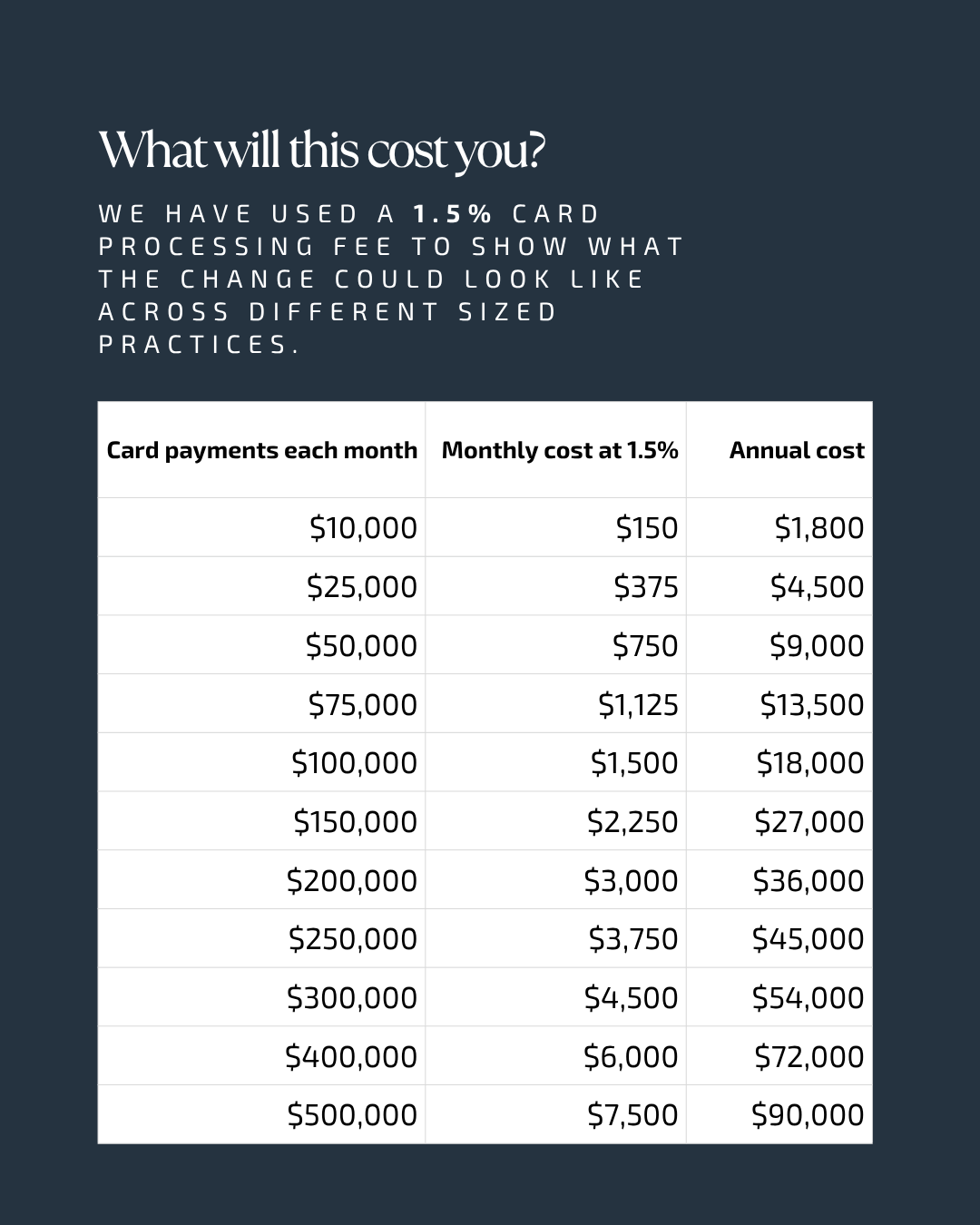
At $200,000 in card payments a year, that is $3,000 in processing costs. At $5 million, it is $75,000.
Your actual cost will depend on how your clients pay, which platforms you use and what those providers charge.
You need to know the impact
To understand your financial exposure, you need to know how payments move through your practice, and how many of them are made by card.
→ How many payments are made by card?
→ Where are those payments being taken?
→ What does each platform charge you to process them?
Card payments can run through reception, your practice management software, online bookings, payment links, stored cards and separate payment terminals or platforms.
Ask your bank or payment provider for your payment and merchant fee data, or review your statements and payment reports. You are looking for your total card payments, the fees you are currently paying and how much you are currently recovering through surcharges.
If you use more than one payment system, make sure you capture each one.
How to reduce the cost
Once you know your numbers, here are some options to assist in mitigating this direct cost transfer:
• Review your merchant fees
Speak with your payment provider about what you will pay from October. Ask what other pricing options are available for your transaction volume and whether your current arrangement is still the best fit.
It may be worth comparing payment platforms to better understand the market rate, support your negotiations or, if it is the better option for your practice, switch providers.
Small differences in processing fees can add up quickly across a year.
• Make a plan for the cost
Once you know the impact on your margins, decide where that cost will sit. That could include a fee review, reducing costs elsewhere in the business, absorbing it within your existing margin, or a combination of approaches.
• Ensure your payment systems reflect the changes
Do not automatically assume your payment systems will make the change for you. Check each platform you use and confirm that surcharge settings have been updated before 1 October.
• Update your team
Make sure your team knows what is changing, when it takes effect and what it means for taking payments and communicating to clients.
• Change your documentation
Review your onboarding documents, fee lists, website, payment terms and any internal policies or procedures that refer to card surcharges or payment fees.
The surcharge is disappearing. The merchant cost is not.
The quick answers
When does this start?
1 October 2026.
Which cards and payment methods are affected?
From 1 October 2026, surcharging will be removed for eftpos, Mastercard, Visa, and American Express. PayPal has also announced it will remove surcharging, with its no surcharge rule taking effect from 5 October 2026.
Can we continue charging card surcharges until then?
Yes. The existing rules continue until 30 September 2026.
Will our payment system remove the surcharge automatically?
Do not assume it will. Check directly with each payment provider and confirm your surcharge settings before 1 October.
What about invoices issued before 1 October?
If a client pays by card on or after 1 October, a surcharge may no longer be available even where the invoice was issued before the change. Check with your payment provider for invoices that cross the commencement date.
Official guidance
The Reserve Bank of Australia has published guidance on the changes to card surcharging and what businesses need to know before 1 October. The ACCC also provides guidance on card surcharges, pricing and the changes businesses should prepare for.
Disclaimer: This article provides general business information only and does not constitute legal, financial, accounting or regulatory advice. The information is based on publicly available guidance current at the time of publication and may change. How the surcharge changes apply to your business, payment arrangements and pricing will depend on your individual circumstances. You should confirm the requirements with your payment provider and seek appropriate professional advice before making financial, pricing or compliance decisions.